

Last Updated: November 15, 2026
Quick Summary
Team practice mixes tactics, passing, scrimmages and conditioning, so no single skill gets focused attention, and few maximal sprints happen. Speed needs short, fully recovered sprint work, plus targeted sprint mechanics coaching that team sessions rarely provide.
- Scrimmages often involve jogging, walking and stopping rather than maximal sprints.
- Conditioning builds endurance, while speed training builds force production with full recovery.
- Speed work works best at the start of practice when athletes are fresh.
- Off-season plans can include two high-quality sprint days separated by at least 48 hours.
- Track your best sprint rep each session, not the average, to measure real progress.
Table of Contents
- Why Team Practice Rarely Builds Real Speed
- Speed Training for Young Athletes: Where Practice Ends and Development Begins
- Sprint Mechanics for Young Athletes: The Skill Team Practice Skips
- Neurological Fatigue Versus Metabolic Fatigue in Team Sports
- How Often Should Athletes Do Speed Training Without Hurting Recovery?
- Speed Training Drills for Team Sports You Can Add to Practice
- Booking Your First Speed Assessment With Antonio Davis Trainer
- Frequently Asked Questions
Why Team Practice Rarely Builds Real Speed
Team practice is where athletes learn to play together, but it is rarely where they get faster. Most sessions mix tactics, passing, scrimmages and conditioning, so no single skill gets the focused attention that speed demands. Coaches who want measurable gains in sprint speed often find that the team format cannot deliver them on its own.
The research on training specificity points the same way. A 2016 meta-analysis of deliberate practice and sports performance published in the Journal of Sports Sciences examined how much deliberate practice explains sports performance, and its results suggest that practice quality matters more than hours logged.
Team sessions also spread effort across many players and many goals at once. An athlete may run only a few true maximal sprints in a full practice. That is far below what a sprint-focused block can deliver.
- Tactical drills rarely push maximal velocity
- Scrimmages often involve jogging, walking and stopping
- Fatigue from the whole session limits quality reps
- Speed work gets squeezed in at the end, when athletes are tired
Speed Training for Young Athletes: Where Practice Ends and Development Begins
Young athletes need a foundation before they need specialized speed work. Team practice builds coordination and game sense, which are valuable. Developing raw speed is a separate job, and it often starts after kids have learned basic movement skills.
Antonio Davis Trainer approaches youth development with an assessment first, so the plan targets the real gap instead of a guess. You can see how a precision assessment identifies what practice is missing before any training is prescribed. You can book a youth athlete speed assessment to see where your athlete stands.
Conditioning versus speed training
Conditioning builds the ability to keep working for a long time. Speed training builds the ability to produce force quickly and recover fully between efforts. These are different goals, and a team that conditions hard may still run slowly at the finish.
A common mistake is treating a hard conditioning session as speed work. The two use different energy systems, and speed quality drops when fatigue sets in. Short, fully recovered sprints are what build speed.
Game speed is not the same as trained speed
Game speed depends on decisions, anticipation and positioning, not just top velocity. An athlete can look fast in a game because they read the play early. Trained speed is the physical capacity to accelerate and reach top speed, and it can exist even when game speed looks average.
Confusing the two leads coaches to think a team has solved speed when it has only improved timing.
Sprint Mechanics for Young Athletes: The Skill Team Practice Skips
Sprinting is a skill, and skills need teaching. Team practice rarely stops to correct posture, arm drive, foot strike or the push off the ground. Without that feedback, young athletes repeat the same inefficient pattern for years.
Good sprint mechanics include a forward lean from the ankles, quick ground contact and relaxed arms moving straight forward and back. These cues are simple, but they need repetition with a coach watching closely. A 2014 PLOS ONE study of sprinters testing deliberate practice theory found that speed development did not follow the simple prediction that more practice always produces faster sprinters, which is one reason technical coaching matters.
- Check posture in short, slow-motion reps first
- Focus on one cue at a time
- Use video to compare technique week to week
- Only add speed volume once the pattern looks clean
Neurological Fatigue Versus Metabolic Fatigue in Team Sports
Fatigue comes in two main forms. Metabolic fatigue builds from the buildup of byproducts after repeated hard efforts. Neurological fatigue reflects the nervous system struggling to fire fast, forceful signals. Team sports tend to create heavy metabolic load, but the neurological cost of sprinting is often what limits speed.
This matters because a tired nervous system slows sprints even when the muscles still feel fine. Coaches can miss this if they only track how hard athletes breathe. Speed work works best when athletes are fresh enough to produce maximal force, which usually means short sets with long rests.
Watch out: an athlete who keeps sprinting while neurologically fatigued can lose mechanics and raise injury risk.
How Often Should Athletes Do Speed Training Without Hurting Recovery?
Most athletes can handle two to three speed exposures a week, but the right number depends on where they are in the season, what else is on the schedule, and how fresh they are when they sprint. The mistake coaches make is treating frequency as a fixed number instead of a variable that shifts with the training calendar.
Off-season: build the quality base
In the off-season, speed work can sit at the front of the week when athletes are freshest. A common pattern is two high-quality sprint days separated by at least 48 hours, with the rest of the week devoted to strength, conditioning and skill work. Because overall practice volume is lower, athletes can tolerate more maximal reps per session, often six to ten sprints in the 10- to 30-yard range with full recovery between efforts.
In-season: protect speed, don't build it
During the season, games and hard practices already supply a large dose of high-intensity running. Most practitioners find that one dedicated speed session per week, placed at least 48 hours from the previous game and 48 hours before the next one, is enough to maintain the qualities built in the off-season. The goal shifts from development to preservation. Adding a second short session of four to six reps is reasonable for athletes who are not playing heavy minutes.
A practical in-season week often looks like this:
- Day after a game: active recovery, mobility, low-intensity movement
- Two days after a game: short speed block (four to six reps, full rest) at the start of practice
- Midweek: normal tactical practice and strength work
- Day before a game: light activation, no maximal sprinting
Recovery markers coaches can actually use
Coaches do not need lab equipment to know whether an athlete is ready to sprint. Simple markers work: resting heart rate taken on waking, a subjective readiness score from one to ten, and a warm-up sprint compared with the athlete's recent best. A drop of more than a few percent in warm-up sprint time, or a readiness score that stays low for two days, is a signal to reduce volume rather than push through.
Watch out: stacking a maximal speed session on top of a hard conditioning day or a game within 24 hours is the most common way coaches accidentally turn speed work into fatigue work.
Returning from injury
An athlete coming back from injury needs a more conservative ramp. A 2025 review of speed, agility and quickness training in soccer players published in the Journal of Sports Sciences reports that dedicated speed training has measurable effects on sprint and jump performance, which supports building it in carefully rather than avoiding it. Start with submaximal runs, progress to controlled accelerations, and only add maximal velocity once the athlete has cleared return-to-sport criteria with a clinician. You can read a step-by-step plan for bridging physical therapy to training, or check how an ACL return-to-sport program is structured.
Speed Training Drills for Team Sports You Can Add to Practice
The simplest way to add speed work is to attach short sprint blocks to the start of practice, when athletes are fresh. Keep each rep close to maximal and rest fully between efforts.
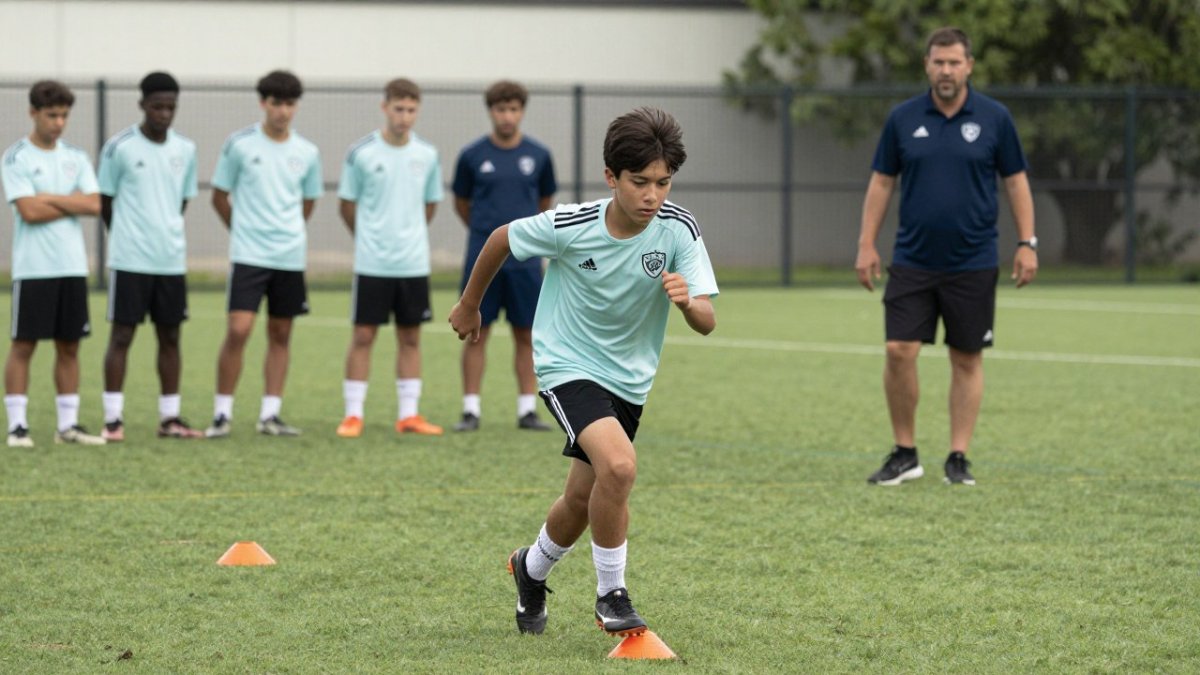
A few drills work well, with the coaching detail that makes them count:
- Standing start 10-yard sprints: Six reps with full rest. Cue a strong forward lean and a powerful first three steps. Watch that athletes do not pop upright immediately; the first two steps should be the longest ground contacts of the rep.
- Flying 20s: Build speed over 30 yards, then run a timed 20-yard segment. This is the best drill for exposing top velocity. Cue relaxed shoulders and quiet ground contact through the timed zone.
- Reactive starts: Athletes react to a whistle or hand signal from a stationary position. This bridges trained speed and game speed by forcing a decision before the first step. Vary the signal and starting posture to keep it unpredictable.
- Short shuttle runs: Five to ten yards with quick direction changes. Keep the volume low and the rest long; shuttles build acceleration and deceleration, not top speed, so do not confuse them with a velocity drill.
Dosage and rest
Speed quality collapses when rest is short. A common guideline is one minute of rest for every 10 yards sprinted, so a 20-yard rep gets about two minutes of recovery. If an athlete's times drop noticeably within a set, end the set rather than grinding out more reps. Total weekly volume for a team-sport athlete is often in the 200- to 400-yard range during the off-season and lower in-season.
Measuring progress without a lab
Coaches can track speed with a stopwatch, a phone camera and a measured stretch of field. Time 10-yard and 20-yard sprints from a standing start, and use a flying 20 for top speed. Record the best rep of each session, not the average, because speed is a best-effort quality. A common pattern is that times improve for two to three weeks, plateau, then improve again after a lighter week, which is a sign the nervous system needed the recovery.
Managing a large group
With 20 or more athletes, run speed work in waves of four to six so each athlete gets full rest and a coach can watch mechanics. Pair athletes by speed so no one is chasing a much faster teammate and losing form. Keep the whole block under 15 minutes so it does not eat into tactical time.
Antonio Davis Trainer builds individualized programming after an assessment. For athletes who want more tailored work than a group drill can offer, one-on-one performance coaching is available.
Booking Your First Speed Assessment With Antonio Davis Trainer
If your athlete keeps hitting the same speed wall, the next step is to find the cause. Team practice helps, but it rarely answers why progress stalls. A precision assessment shows what practice is missing before any program is prescribed.
Antonio Davis Trainer builds assessment-driven programming, so training can target what actually needs work. Pricing depends on the program and schedule, so contact Antonio Davis Trainer through the website for current details.
BUTTON: Book Your Speed Assessment CARD_TITLE: Why is my athlete stuck on speed? CARD_TEXT: Antonio Davis Trainer uses precision assessments to find the exact gap before any program is built.
Frequently Asked Questions
How often should young athletes do speed training?
Most young athletes benefit from two short, high-quality speed sessions per week, each lasting about 15 to 25 minutes, with full recovery between sprint reps. Sessions should stop before technique breaks down, because fatigued sprinting trains bad habits. During the competitive season, one session per week is often enough to maintain gains while protecting recovery. Rest days matter as much as the training itself, since adaptation happens between sessions, not during them. Coaches should adjust frequency based on school load, travel, and how the athlete recovers from games.
Does speed training really work for young athletes?
Research supports it. A 2025 review in the Journal of Sports Sciences reports that previous studies have shown speed, agility, and quickness training improve sprint, change-of-direction, and jump performance in soccer players. A 2016 meta-analysis in the Journal of Sports Sciences also examined how deliberate practice relates to sports performance. Practice in a team setting exposes athletes to speed but rarely isolates the mechanics and force output that make them faster.
How is speed training different from team practice?
Team practice is built around tactics, positioning, and game scenarios, so sprints are usually short, unplanned, and performed while fatigued. Speed training isolates the variables that determine how fast an athlete accelerates and reaches top speed, such as sprint mechanics, force production, and recovery between reps. Team practice trains athletes to use speed in context. Speed training develops the speed itself. Both matter, but only one reliably changes how fast an athlete can run.
